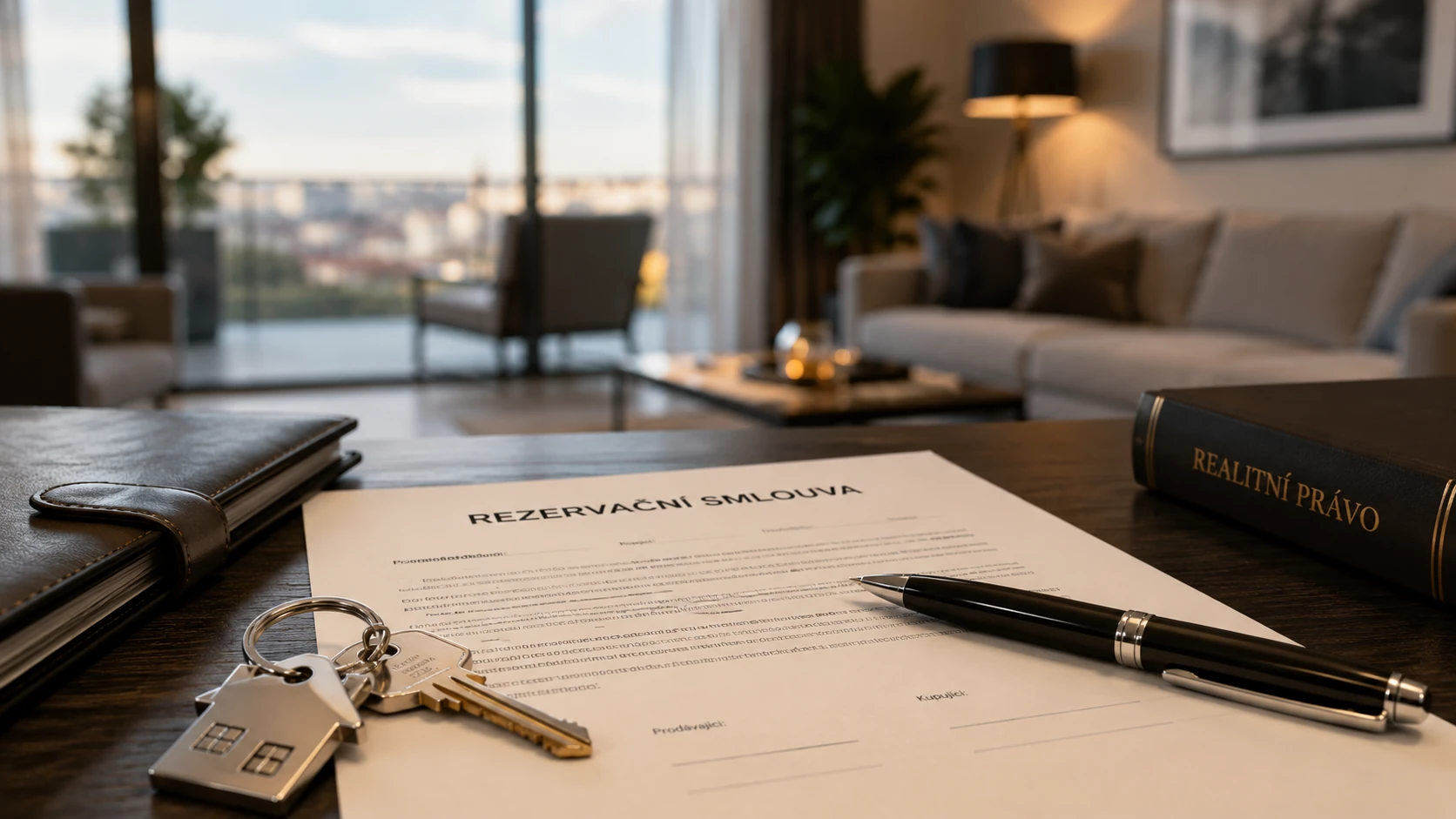
You have found an apartment you like. The agent hands you a reservation contract and says: "Standard document, nothing complicated." And you — in the excitement of having found the property — reach for the pen.
Stop.
A reservation contract is not an administrative formality. It is a binding legal document that defines the terms on which you are buying and what happens if anything gets complicated. Signing without understanding what is in it is one of the most expensive mistakes buyers make.
Here are five things you should know before picking up that pen.
1. What is the reservation fee and what happens to it?
The reservation fee typically ranges from 1 to 3 % of the purchase price — in the case of Prague apartments, that is tens to hundreds of thousands of crowns. The key question is: what happens to it if the deal falls through?
If the seller withdraws, you get the fee back — usually doubled. If you withdraw, you forfeit it. But pay attention: the contract must clearly define what constitutes "withdrawal by the buyer" and what situations entitle you to walk away without penalty (for example, a rejected mortgage application, or a significant hidden defect).
Always ask: Does the contract explicitly state the conditions under which I may withdraw without losing the fee?
2. What exactly is the subject of the purchase?
You are buying an apartment. But what exactly? The unit number in the land register, the precise floor area, a cellar compartment, a parking space, the share of common areas — all of this must be explicitly stated in the reservation contract. Anything not written down does not exist.
I have seen contracts where the "parking space included in the price" was missing from the text and the seller later acted surprised. Ask to see the title deed and verify that the subject of the contract matches the land register.
3. What is the condition of the property and what is the seller not telling you?
Sellers are legally required to disclose known defects. In practice this does not always happen. Before signing the reservation contract, have someone assess or find out for yourself:
- The structural and technical condition (cracks, damp, condition of utilities)
- The ownership history — changes in the land register in recent years
- Liens, easements, pre-emption rights
- The status of the homeowners' association or housing cooperative: is there money in the reserve fund? Are renovations planned?
The reservation contract does not guarantee that the property is in good order. It only guarantees you the opportunity to buy it.
4. What is the binding deadline for signing the purchase contract?
The reservation contract sets a time frame — typically 30 to 90 days — within which the purchase contract must be signed and the purchase price paid. If you are financing with a mortgage, this deadline is critical.
The bank needs time: a property appraisal, loan approval, drawdown. In practice the entire process can take 6–8 weeks. If the deadline in the reservation contract is shorter, you will find yourself under pressure — and pressure when signing a purchase contract is not a good thing.
Always find out whether the deadline can be extended and under what conditions.
5. Who drafted the contract and who is reviewing it for you?
The reservation contract is typically prepared by the agent or the seller. That in itself is not a problem — but it is a reason why you should have it read by someone who represents your interests.
Legal review of a reservation contract costs in the order of CZK 3,000–8,000. The reservation fee you could lose due to a poorly drafted contract is typically CZK 100,000–300,000. The maths is clear.
Buying an apartment is probably the biggest financial decision of your life. The reservation contract is its first step — and first steps matter.
If you are not sure what you are signing, or would like an independent perspective on a specific offer — call me. I have been through hundreds of these contracts and I know where the traps tend to be.